ENGLISH BRIDES OF ABORIGINAL SOLDIERS OF WW1

During the course of WW1 and immediately after, an unknown number of members of the AIF who were stationed in England, on leave or convalescing, met and married English women. In most instances details of the marriage are contained in a serviceman’s record – in AIF form 527. In some cases marriages were recorded in studio portraits like that of Gordon Naley, following his return from POW camp in Germany. After the war ended these war brides and sometimes fiancées travelled to Australia on His Majesty’s Transports, usually with their husbands and often accompanied by children. The arrival of one such ship was reported in the West Australian on 3 November 1919:

 Monday 3 November 1919. HMAT Mahana arrived at Fremantle late yesterday afternoon, She had on board 1,151 passengers of whom 46 were civilians, 124 soldiers, 431 female dependants of soldiers and 110 children … Three infants died on the voyage out and two were born. Otherwise, the voyage was uneventful. The ship is stated to have been a very happy one. It is expected that the Mahana will continue her voyage to the Eastern States this morning.

A Miss Campbell, known affectionately to the soldiers as ‘the girl with the flags’, gained fame during the course of the war for the welcome she gave to troop ships passing through Durban, South Africa. She described in verse the arrival in 1920 of the last ship to Australia, the Shropshire. After heralding the ‘Dear Aussie Soldier men and English Brides,’ she went on to write

And now the last one goes a family ship
Fair English faces smile beside
The lean tanned faces of those hero men,
And baby faces peer between the rails,
Or wave a wee hand from their vantage place,
High in their father’s arms the last ship sails
Oh! may those babies never have to cross
The world, in years to come for such a war

What she may not have known was that some of the men returning with their wives were of Aboriginal heritage. Aboriginal men who married overseas so far identified are Arthur Andrews, Ernest Andrews, Walter Coe, Joseph Crowley, Harold Frazer, Charles Miller, George Morley, Gordon Naley, Arthur Ruttley and Alfred White. Miss Campbell’s wish was not granted and the sons and some daughters of veterans of the First World War did ‘cross the world’ to fight in other wars. Amongst these were sons of Indigenous servicemen Walter Coe and Gordon Naley.

Philippa Scarlett 29 March 2013

Posted in WW1 | 6 Comments

WILLIAM STUBBINGS: ABORIGINAL SOLDIER OF THE BOER WAR

On April 13th 1791 Watkin Tench, a young officer in the Marines, recorded a meeting on the banks of the Hawkesbury river between Arthur Phillip, Governor of New South Wales and members of the Boorooberongal clan of the Darug.

We halted for the night at our usual hour, on the bank of the river.
Immediately that we had stopped, our friend (who had already told us his name) Gombeeree, introduced the man and the boy from the canoe to us. The former was named Yellomundee, the latter Deeimba. The ease with which these people behaved among strangers was as conspicuous, as unexpected. They seated themselves at our fire, partook of our biscuit and pork, drank from our canteens, and heard our guns going off around them without betraying any symptom of fear, distrust or surprise. On the opposite bank of the river they had left their wives and several children, with whom they frequently discoursed; and we observed that these last manifested neither suspicion or uneasiness of our designs towards their friends. [Sydney’s First Four Years  pp. 229 – 230].

Just over 100 years later William James Stubbings a great grandson of Yellomundee/Yarramundi, left Australia to fight in the Boer war. William Stubbings is one of the small number men of Aboriginal heritage known to have taken part in this conflict. He served in South Africa from 1899-1902 with D Squadron of the 3rd Regiment, New South Wales Mounted Rifles with Regimental Number 1533

WLLIAM STUBBIINGS 3rd NSW Mounted Rifles Boer War  Courtesy  Kym Stubbings

                                                                              William Stubbings courtesy Kym Stubbings

His mother, Martha Lock was the daughter of Maria Lock and a granddaughter of Yarramundi. Martha was born in Blacktown in 1847 and married William James Stubbings (senior) in 1866. The Aborigines Protection Board minutes for 2 August 1900 record the discontinuation of rations to families in the Rooty Hill area, including the family of William Stubbings. [J. L Kohen Daruganora 2 2009, p.123.]

Since the establishment of the Protection Board in 1883, Darug families, like other Aboriginal families in New South Wales, had suffered increasing government interference with their lives including the removal of children. Despite this William Stubbings, the son of Martha and William, was amongst those who sought to fight in Britain’s colonial war in South Africa.

In early 2013 Kym Stubbings, in contact with another Lock descendant Liz Locke, wrote:

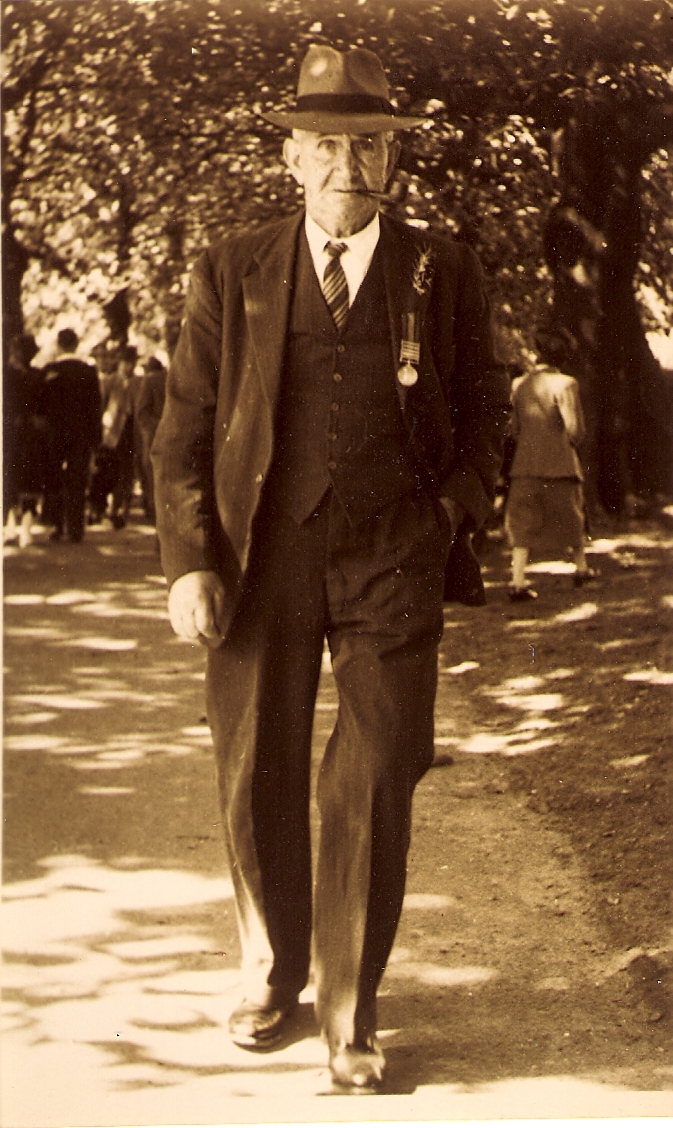
My great Grandpa was William James Stubbings. His son, Stanley William Stubbings, my much loved Grandpa left me as custodian of his dad’s Boer war medal and photo. I also have a copy of a much later photo of Great Grandpa marching on Anzac day with his medal proudly displayed.

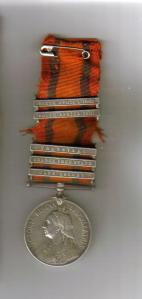
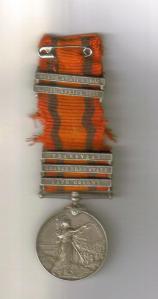
Boer War medal William Stubbings courtesy Kym Stubbings Boer War medal William Stubbings reverse courtesy Kym Stubbings

William Stubbings’ Queen’s South Africa Medal courtesy Kym Stubbings.

The medal is officially described as:

a silver and bronze medal with the crowned and veiled head of Queen Victoria on the obverse. The reverse has Britannia with a flag in her left hand holding out a laurel wreath to a party of advancing soldiers. In the background are two warships. Below the wreath the dates ‘1899-1900′ are shown. [Note these are not apparent on this medal] Around the top are the words ‘SOUTH AFRICA’.

The clasps attached to the ribbon refer to:

Cape Colony 11 October 1899 to 31 May 1902
Orange Free State 28 February 1900 to 31 May 1902
Transvaal 24 May 1900 to 31 May 1902
South Africa 1901 1 January 1901 to 31 December 1901
South Africa 1902 1 January 1902 to 31 May 1902

The service in South Africa of the 3rd New South Wales Mounted Rifles, indicated by these clasps, has been summarised by the Australian War Memorial:

The regiment travelled to South Africa in three group: B and D Squadrons were the first to leave Australia, sailing from Sydney on 15 March, on board the transport Maplemore; A, C, and E Squadrons, and the regimental staff, followed six days later on the British Princess. The machine gun section also left on 21 March, travelling on the transport Ranee. B and D Squadrons disembarked at Port Elizabeth on 12 April, while the rest of the regiment disembarked at Durban on 17 and 23 April. … From 2 May 1901 to 28 April 1902 the regiment served in the eastern Transvaal and in eastern Orange Free, attached to Colonel Remington’s column. In early 1902 it took part in several drives, the principal one being the Harrismith drive, which resulted in the capture of 251 prisoners, 26,000 cattle, and 2,000 horses. In February 1902 the regiment was in action during the Boer breakthrough at Langverwacht. In May the regiment embarked at Cape Town for Australia, leaving on 4 May and reaching Sydney on 3 June, after having stopped at Albany, Adelaide, and Melbourne.

There is no evidence that this William Stubbings served in WW1, but the photograph belonging to his great grandchild Kym Stubbings shows that he marched on Anzac day. This image probably dates from the 1940s or 50s. William Stubbings died in 1957. His Boer war medal is worn below the rosemary on his left lapel.

WILLIAM STUBBINGS Anzac Day 1940S or 50s  courtesy Kym Stubbings

Courtesy Kym Stubbings

This photograph plus the portrait of William Stubbings in uniform and his Queen’s South Africa Medal, are possibly the only objects now existing which specifically relate to the service in the Boer war of a man of Aboriginal heritage.

Philippa Scarlett 28 March 2013

Posted in BOER WAR | 5 Comments

PERCY KENNEDY ABORIGINAL JOCKEY : RACING IDENTITY AND FINE HORSEMAN

John Maynard’s  Aboriginal Stars of the Turf is described as celebrating ‘the significant and exciting Aboriginal involvement in Australian racing history. Amongst the many Aboriginal jockeys highlighted in the book are Merv Maynard, Norm Rose, Frank Reys, Richard Lawrence ‘Darby’ McCarthy and Leigh-Anne Goodwin, Australia’s first female Aboriginal jockey to ride a winner at a metropolitan track’.

Recently research by Wiradjuri woman Denise Hayes has led to the discovery of another star of the turf – her great grandmother’s brother, Percy Kennedy. Percy Kennedy was born in 1874, the son of David Kennedy and Amelia nee (Bryant) a Wiradjuri family living from the 1880s at Warangesda mission Darlington Point NSW. While a number of David and Amelia’s children remained at Warangesda or in the Darlington Point area, Percy moved to Melbourne where Denise has established he became a respected steeple chase jockey in the 1890s, working primarily in the stables of Mr J. E. Brewer. Fellow jockey Bobby Lewis, who described Percy as ‘a racing identity and fine horseman’ wrote in his memoirs that ‘I suppose everyone who has had much to do with racing in Victoria knows the dark-skinned Percy.’

By the 21st century Percy’s move to Melbourne and marriage to a non Aboriginal woman were largely unknown to his Kennedy family in NSW. Denise did find another relative – a first cousin once removed, who knew of him but most of the family, even the oldest, were unaware of Percy’s history after leaving NSW.

Percy’s career and idiosyncratic character is documented in contemporary newspapers which record him riding in Melbourne, Brisbane and Perth and include one account testifying to his quick wits and bravery.

In connection with the fight between Selim
and Forward at Caulfield last week (says the
Sportsman) a specially plucky bit of work has
escaped notice. While the horses were at their
maddest Percy Kennedy, the coloured lad who
rode Selim when he won his first welter race,
rode up to the fighters and at great risk seized
Forward by the nostrils. The horse reared up
suddenly, dragged Kennedy out of the saddle,
and tried to trample on him. But the lad held
on in the gamest possible manner, and
succeeded in parting the fighters. The opinion
of an eye-witness is that but for Kennedy’s
gameness Selim and Forward would have torn
one another to pieces.
The Brisbane Courier 22 December 1894

Denise found that Percy had only one child – a son born 1897, also named Percy. He volunteered for the first AIF on 6 July 1915 and died of tuberculosis in England on 16 September 1916. Prior to this he had served in Egypt and France.

Percy junior was under age when he volunteered – only 18 – and his father’s consent is recorded with his enlistment papers. His mother had died before the war. However comparison of this letter of consent with later correspondence between Percy senior and AIF base records suggests that the consent letter could in fact have been written by the younger Percy.

The letters in the service record of his son are the last evidence of the existence of Percy Kennedy so far located. These records help in charting Percy’s addresses in the early 1920s but details of his later life have proved elusive. If as Bobby Lewis said ‘everyone who has had much to do with racing in Victoria knows the dark-skinned Percy’ perhaps somewhere there is more information about the early career and subsequent history of this unusual man.

Post script

Percy’s brother David Kennedy volunteered for WW1 but was discharged as medically unfit. He was at least 44 when he tried to enlist. Percy’s nephew Sidney/Sydney Wilson served in WW1 with the Light Horse and in the militia in New Guinea in WW2.

My thanks to Percy’s great grand niece Denise Hayes and latterly to great grandniece Anita Bayliss

Philippa Scarlett 9 March 2013

Posted in Aborigines sport, WW1 | 2 Comments

WHAT WOULD CHARLES BEAN HAVE SAID ABOUT GEORGE CAMPBELL HUNT AIF

Thanks to writer John Tognolini I’ve recently located George Campbell Hunt of the 21st Battalion, AIF.

John was gathering information about his uncle Stephen Tognolini M.M when he discovered George Hunt in a group photo of the 21st Battalion taken in Picardie, Somme in June 1918. George Hunt fought at Gallipoli and later in France and rose to the rank of Company Sergeant Major.

George Hunt’s service record describes him as of ‘swarthy’ complexion with brown eyes and black curly hair. His photograph (reproduced by John Tognolini from the collection of the Australian War Memorial) clearly shows he is ‘not of substantial European origin’ – and so ineligible to become a member of the AIF. But like many others he was accepted by the military authorities and after serving for four years was killed in action on 6 July 1918 at Hamel, France. His name on the Australian War Memorial Roll of Honour is accompanied by a studio portrait.

In the previous year, following the second battle of Bullecourt (3–15 May 1917) Hunt was awarded the Distinguished Conduct Medal. The citation reads:

For conspicuous gallantry and devotion to duty.
He led his battalion forward in an attack with great coolness and courage and although twice wounded assisted to evacuate the wounded, resuming his command after his own wounds had been dressed.
Fourth Supplement No. 30234 to the London Gazette dated 14 August 1917

His own description of the events of that day was published in the Maryborough & Dunolly Advertiser of 13 July 1917, p4.

DEED OF DISTINCTION, HOW SERGEANT HUNT WON D.C.M.
Some little time ago we announced that Sergeant G. C. Hunt, of Maryborough, had succeeded in winning the D.C.M. for valorous conduct on the field. In a letter to his wife, Mrs. Hunt, of Napier street, he describes the incident which gained him the distinction. The letter is dated May 10, and reads: “Well, here I am at last. Have not been able to write much before. In fact, I shall have to send this to friends in England, as I hear that no mail is to go to Australia for quite a few weeks. We have just got out after a big, terrible battle with Fritz. I thank God I got out alive, although I am walking about covered all over with bandages shrapnel wounds in head and hand, and a bomb wound in the leg. Three separate occasions during the day of the terrible battle I brought in a badly wounded captain, and also a corporal, never thinking of myself all the time. Shells, shrapnel, bombs, and machine gun fire all over No Man’s Land. I also got in to some very hot scrapes. At one place three Fritzs came at me all of a sudden with bombs, and I luckily got in first with my revolver. I actually kissed my revolver for saving my life. More good news: I would not go away when the doctor sent me, but said my place was with my men. I have been strongly recommended for the D.C.M. I guess you will be proud of me now. I am feeling O.K.

George Hunt may have been Aboriginal but it’s possible  he could also have been of African or Indian heritage. Information in his service record says his father was also George Hunt and that although enlisting from Maryborough Victoria, he was born in NSW, in Newcastle in 1878. The birth of a George Hunt, son of George and Frances Hunt was registered in Newcastle in 1877. It is feasible that Hunt may not have stated his age accurately – he was already older than the average volunteer.

But whatever the facts of his heritage, it is clear that his enlistment and distinguished service is another example of the existence of men of non European origin in the AIF, challenging the popular perception of this band of men as white Australians.

Posted in Other non white Australians and the AIF, WW1 | 2 Comments

ABORIGINAL SOLDIERS AND GALLIPOLI

In 1933 a former private in the 15th Battalion drew attention to the service of Aboriginal men at Gallipoli when he said ‘I have stood shoulder to shoulder with half castes in Hell’s pit [Hell’s Spit], on Quinn’s Post, and seen them die like the grandest of white men.’ In subsequent years the existence of Aboriginal soldiers at Gallipoli and in World War One as a whole, was largely erased from Australian history. During the last decades of the 20th century this situation slowly began to change. Yet, as recently as 2001, Les Carlyon, in his book Gallipoli (described as a ‘definitive history’) denied Aboriginal men a place in what many Australians regard as the most significant campaign in their history.

That there were Aboriginal men at Gallipoli we do know – the question is how many. Recent estimates of the number of Aboriginal men killed or surviving the Gallipoli campaign have varied from the mid thirties to a conservative seventeen.

Lists compiled in the past of Aboriginal men who served in World War One, including Gallipoli, have included individuals who were not Aboriginal or whose Aboriginality needs clarification. The James Lucas, 953, born Mudgee NSW, who enlisted in Queensland and died at Gallipoli is one of a number of problematic servicemen. There is an Indigenous James Lucas from Queensland who is documented in 1897 (1) but he is unlikely to be the James Lucas from Mudgee. I would welcome any information confirming Aboriginal heritage for a serviceman of this name. AIF records available for view on the National Archives of Australia website (in series B2455) show that eleven men named James Lucas volunteered for World War One.

The issue of identification raised here emphasises the importance of accessible referencing when talking about Indigenous service in general and Gallipoli in particular. The compiler of one list of Indigenous World War One servicemen has observed that it is in the nature of history to be self correcting. This is sometimes true but unfortunately not always. It is now close to April 2013. The 2015 centenary of Gallipoli is fast approaching and time for history to assist is running out. This makes it all the more important to place the identification of the Indigenous men of this campaign on a firm basis.

(1) Regina Ganter and Ros Kidd ‘The powers of protectors: Conflicts surrounding Queensland’s 1897 aboriginal legislation’. Australian Historical Studies, Vol 25, 101, 1993 pp. 536-554

Philippa Scarlett 24 February 2013

Posted in WW1 | 12 Comments

WW1 SERVICE RECORDS AND THE CLARENCE VALLEY PHOTOGRAPHS BY JOHN WILLIAM LINDT

Information in the service record of a World War One Aboriginal soldier has been used to assist with the possible identification of the photograph of a young woman in a collection of images of Aboriginal people from the Clarence Valley NSW. These were taken by John William Lindt in the 1870s and in 2004 saved from being sold overseas by a businessman and collector Sam Cullen and his wife Janet. They not only purchased the collection and donated it to the Grafton Regional Gallery but with others have strenuously endeavoured to find out the identity of the Aboriginal men and women who are its subjects.

Sam Cullen and those involved in the search both before and after their purchase have had few clues to work with. However one, the pencilled name ‘Mary Ann of Ulmarra’ on the reverse of the photograph of a young woman, has led them to some promising connections. Using information in the World War One attestation of Harold Arthur Cowan, an Aboriginal member of the 6th Light Horse, plus marriage registrations and family information, it has been possible to suggest the young woman’s identity and to place her in a Clarence River family.

The story of the purchase of the photographs and of the Cullens’ efforts to put names to the people and to meet members of the Clarence River Indigenous community (possibly the descendants of Lindt’s subjects) was the subject of a recent ABC television program Australian Story. In this Nola Mackey, a local Grafton historian, described the way her research progressed after she made contact with elder Debbie Taylor:

Debbie told me that she had a great uncle called Harold Arthur Cowan and he’d gone to stay with an aunt, Mrs Williams, in Grafton. Harold Arthur Cowan went to the first world war and so I went online and found his World War 1 papers and these revealed very interesting material in the fact that his next of kin was Mrs Mary Ann Williams. I found a marriage certificate which turns out that her maiden name was Mary Ann Cowan, which then led me further to suspect there may be a family connection because Debbie’s great grandparents were Cowans. I also started to wonder if this Mary Ann could possibly be the Mary Ann of Ulmarra. She was born near the back of Ulmarra so this put us in the right place then when their ages were calculated it also put them in the right age group that it could possibly be this Mary Ann of Ulmarra. And within all the hundreds of searches I’ve done looking into records, this is the only Mary Ann that I have ever found. (Australian Story Transcript)

Nola’s conclusion was strengthened by comparison of the photo of Mary Ann with one of Harold Arthur Cowan in AIF uniform. Nola and Debbie also immediately saw a likeness between the two individuals:

Straight away I was struck with some of the similarities between these people. The eyes of Mary Ann of Ulmarra and the eyes of Arthur Cowan as we know him, the mouth. And therefore there’s a great possibility Mary Ann Cowan was actually Debbie Taylor’s great great aunt, that she is connected to MaryAnn of Ulmarra. (Transcript)

The participation of Harold Arthur Cowan in World War One, documented in his service record and the photo which his decision to join up generated, have played a not inconsiderable part in this story. The involvement of these two sources of information provides yet another illustration of the fact that the act of volunteering for World War One led to the creation of records about an individual whose value extends far beyond the military context in which they were produced.

Philippa Scarlett 11 February 2013

Posted in WW1 | Leave a comment

BOER WAR: ANOTHER ABORIGINAL SOLDIER CONFIRMED

In early 1900 five Aboriginal men from Warangesda Mission, Darlington Point offered their services as scouts to the New South Wales Bushmen Contingent which was to leave for South Africa later that year. [D and B Elphick, The Camp of Mercy  p.26]. Although their offer was not accepted, Dr Dale Kerwin of Griffith University estimates that at least 50 Aboriginal men went to the Boer War as troopers, trackers and stock handlers.

As early as 1993 details of the Darug heritage and enlistment of William Stubbings a trooper with the 3rd NSW Mounted Rifles were published in James Kohen’s The Darug and their Neighbours: The traditional Aboriginal Owners of the Sydney region. Since then new names of Indigenous Boer War servicemen have been sought and researched, together with existing names, in an effort to confirm Aboriginality and service. Research over the last five years by historian Peter Bakker of Hamilton, Victoria  has recently led to more information about the Boer War service of John Robert Searle (enlisted as Robert Charles Searle) 4th Western Australian Mounted Infantry and the discovery of the name of his Aboriginal grandmother, who was kidnapped from the Port Phillip District in the early 1830s.

While Searle has been noted as Aboriginal on some Boer War listings, to date there has been little information about his Indigenous heritage. This has now been traced by Peter Bakker and confirmed in consultation with Searle family descendants and a host of primary and secondary sources, including a rare photograph of John Robert Searle in the possession of a family member, Pat Keenan.

Peter Bakker recently travelled to Albany, WA in connection with his research and his comments, reported in the Albany Advertiser of 24 January 2013, throw more light on his findings. The Advertiser notes that this is not the first time Searle’s service has been mentioned in its pages which 113 years earlier recorded his enlistment and embarkation for South Africa.

Peter Bakker’s research (to be published in full at a later date) is important because by linking his own findings with information from the Searle family it is now possible to name a descendant of the Bunurong people of the Kulin nation of Victoria as an Australian soldier  of the Boer war.

Philippa Scarlett 7 February 2013                                                                                                                                                                                                                                                             NOTE .  In ‘Troopers, not trackers ‘published in 1917 in Wartime Magazine No. 81, Peter Bakker and Thomas Rogers  show that there is no proof that 50 Aboriginal men went to the Boer War as trackers and were denied return to Australia.

Posted in BOER WAR | 3 Comments

ABORIGINAL WRITING: LETTERS AND DOCUMENTS IN WW1 SERVICE RECORDS

Writing Never Arrives Naked: Early Aboriginal cultures of Writing in Australia (2006) by Penny van Toorn dispels the once popularly held belief that David Unaipon’s publication of Aboriginal legends in 1927 and 1929 were the first examples of Aboriginal writing. Van Toorn points out that Aboriginal people, first in the Sydney area and later in other parts of Australia, have been expressing themselves in writing for over two centuries.

She shows that although Aboriginal writing is couched in European forms and conventions, it can contain cultural references which have not been immediately obvious to western eyes. Amongst other things, she points out and deduces much from the fact that institutional control of Aboriginal people by missionaries and government in the 19th century was the agent for and a major source of Aboriginal writing.

The incorporation of Aboriginal people into another type of institution in the early 20th century – the Australian Army and within this the first AIF – was also a source of Aboriginal writing. This incorporation was voluntary and not associated with the coercion and domination which characterised the control of Aboriginal lives by government and missionary. In fact, Aboriginal men were excluded by the Defence Act from joining the AIF and their presence there was the result of less than rigorous interpretation of enlistment regulations. However despite this basic difference, the incorporation into the bureaucracy which was the Army, like that of mission and government stations, also created the circumstances which resulted in writing by Aboriginal people.

Although World War 1 service records did not form part of the spectrum of writings examined by van Toorn, the written interactions with the Army of Aboriginal servicemen and their relatives can also be interpreted. van Torn seeks and finds answers to the question  ‘How and why [an Aboriginal] individual at this point in their history acquired, conceptualised, organised and used their particular reading and writing practices in the manner they have’ [p. 11]. I seek to use Aboriginal writing in WW1 service records to locate personal details often lost or even unknown in the 21 st Century and as an unexpected source of both direct and indirect information about the writers and their families.

The writing in service records, like much of the writing from missions, was mostly directed to authorities asking for action or seeking information. It is generally formal and often deferential in character. Something which gives it additional value is that the letters and the notes with the attestation and official forms in a service record may be the only examples of writing by the serviceman or his relatives which survive – perhaps in some cases the only examples ever to exist.

Amongst documents in service records are letters from some well known Aboriginal men. Herbert Groves wrote about the disposal of the medals of his step brother, Ernest Williams and William Ferguson about one of his sons, Duncan. Another letter writer, James Bowen Budsworth, was the son of Kitty one of the first Aboriginal girls placed in Governor Macquarie’s Native Institution at Parramatta in 1814. It is possible to speculate that his strong writing skills stem directly from the training received by his mother. His many letters arise from the service in France of his son Roderick, who was first posted missing then recorded as killed in action. These letters mainly to AIF Base Records were written prior to and after the news of Roderick’s death – one even asking that thanks for a royal letter of sympathy be conveyed to the King. They are always formal and carefully courteous in expression but the content can be personal as in the physical description he provided to assist in his son’s identification and his reply to Base Records’ initial inquiry about his missing son:

Sir

The only information that I have received of my son Private R H Budsworth is herewith enclosed and which I trust you will return to me again when you have done with it.

My son never wrote to me since he sailed from Sydney. Excuse my carelessness in dropping ink on the paper

Yours faithfully

J B Budsworth  7 September 1917 

In addition linking the addresses in Roderick Budsworth’s service record with those in the WW1 records of other Budsworths, shows three generations of his family living together at the same location in Tamworth NSW.

Despite the formal nature of most letters, occasionally emotion breaks through. A number of letters were written to AIF Base Records and to the Minister for Defence by Mrs Darcy [Agnes] Webb, aunt of William Castles. She and her nephew were both descendants of Yarramundi, chief of the Boorooberongal clan of the Darug. One of these shows the grief and pain she was experiencing on learning of her nephew’s death after service in France:

I am writing to you in reference to my Poor Dear Nephew’s Death asking you if you could furnish me with the Particulars of his Death. The minister Mr. Johnson has brought me a Telegram today. My nephew W Castles No, 2507 54 Battalion Died at sea on the 23rd of last month … it left me hardly able to move with the shock I had received from the Rev Johnson. I would like you if you could to find out if my poor lad left me a Message or a Will  …  if the military would kindly forward the full particulars of his death and also his belongings as I would like to have them for a dear keep sake knowing my dear Nephew died through wounds fighting for his King and Country which he was eager to do. Trusting you will grant me this as I am his Aunt and Next of kin … for God’s Sake help me to get Something.

[undated letter to G Pearce Minister for Defence, received 13 Nov 1917]

Castles’ record also contains letters from his brothers Jack and Edward.

John Henry Alfred Coe’s service record contains a series of letters written by his widow and children about the disposal of his service medals, following his death in France in 1917. These letters reveal family relationships and the locations of family members in the post war period to the 1960s. Such information in letters is not uncommon in service records and of great value to later generations seeking to find out about their forbears. The value of letters like these in the service records of the Lock family is explored in The Lock Family in World War One: how service records contribute to Darug history.

A common source of correspondence was loss of a man’s discharge papers. The imperative to write was the fact that production of a discharge gave WW1 returned soldiers preference for employment. The information provided by men in the forms and letters often accompanying their requests for a replacement discharge also has something to say about the post war employment of Aboriginal men. A common reason for losing a discharge is that it was burnt in camp. This indicates occupation – itinerant work or droving – and often when compared with the place of birth or contact address in a service record, places an individual far from his own country. Born at Lake Condah, Victoria and enlisting at Healesville, David Mullett wrote letters from addresses at Bega and Bundure via Jerilderie in NSW in the 1920s and 30s and also indicated his attitude to his war service in his intention to take part in the Sydney Anzac day march of 1938. As well as movement, his letters show his circumstances and pension status.

While service records rarely include personal letters between individuals, one exception is the copy of a note to his friend in the 52nd Battalion, Dan (Denis Hampson) which accompanied the will of George Aitken. Aitken was killed six months later in Belgium on 19th October 1917. This shows the friendship between Aitken and his white mate and also gives an insight into the man himself and his resignation to the inevitability of death created by over a year’s service in France and Belgium.

2441 Pte. D T Hampson 5Reinforcements 52 Bn. On the date of February 10th 1917 From Jim

Just a little story of our friendship well Dan I can safely say that we are the only true mates there are in the world That’s a big word to say Well Dan if I gets nocked you can have anything you find on me that is any used to you and my allotted  money to be left to Mrs T Hampson. Show this to one of the heads don’t forget. only a pte. G. R. Aitken No 2367

Goodbye old man and good luck to you wishing you all sorts of luck to pull thorough this war we have been the very  best of mates and only one thing I wish that we could meet over other side of the world if there is any such place is that I don’t think I shall ever forget you Dan I will think of you when I am dead never used to say much to you when we used to nocked about together I was very funny like that anybody that I like never say much to Goodbye and old man good luck.

 The examples here are from only a few of the over 800 service records from WW1 so far identified as belonging to men of Indigenous heritage. Many of these records have yet to be investigated more closely. More letters and other communications in the records have the potential to yield valuable information about the men, their families and aspects of their Indigenous identity.

The service records of men of the first AIF have been digitised and can be read on the National Archives of Australia website.

Philippa Scarlett 6 February 2013

Posted in WW1 | 8 Comments

MORE TASMANIAN ABORIGINAL SOLDIERS WW1

Andrea Gerrard, now a Ph.D. student at the University of Tasmania, has been researching Tasmanian Aboriginal soldiers from WW1 for a number of years. The names of the 64 soldiers she has identified were published in the Hobart Mercury on 9th November, prior to Remembrance Day, 2012.

The results of her research were not available when Aboriginal and Torres Strait Islander Volunteers for the AIF: The Indigenous response to World War One, was first published in 2011. However 48 of the names now made public by Mrs Gerrard were listed in this edition together with the names of a further seven men which do not appear in the Mercury list. What is exciting about Mrs Gerrard’s research is that it has enabled her to name an additional sixteen volunteers, including more members of the families of men mentioned in Aboriginal and Torres Strait Islander Volunteers.

Mrs Gerrard’s list as it appears in the Mercury is not referenced – but subject to this, the sixteen new names she puts forward bring the number of identified volunteers from Tasmania to 71 and boost the number of volunteers, excluding second enlistments, to 838. It is inevitable that this number will grow as new names are discovered and others already known are confirmed.

Writing in 2011 Mrs Gerard had this to say about her research:

Private John William Miller who served with the 12th Battalion was the grandson of Fanny Cochrane Smith who was a well known identity in both the white and aboriginal communities. Private Miller was killed at the landing at Gallipoli. It was John Miller that started me on this journey and as an historian it is a privilege to work on this group of men. None needed to enlist, but the fact that they did so, often against the odds is worth celebrating. Aboriginal Anzacs AWM Blog 17 April 2011

Mrs Gerrard states that she has found the only Aboriginal officer to date. This could change but as it stands her discovery and research are important milestones in the journey to unfold and make known the part played by men of Aboriginal heritage in WW1.

Philippa Scarlett 13 January 2013

Posted in WW1 | 1 Comment

WALHALLOW: THE FIRST ABORIGINAL WW1 MEMORIAL?

On 17 August 1935 The Sydney Morning Herald noted the existence of a memorial to men who had served in World War One from Walhallow Aboriginal Station. Walhallow is at Caroona 20 miles west of Quirindi New South Wales. The article was titled THE GATE OF MEMORY. Raised by Coloured Folk and read in part

It is at the gateway to the school that we find the “Gate of Memory,”   This, the first of its kind in Australia, was unveiled early this year. On the tablet inserted in the wall is the following:
This tablet was erected in honour of those men resident on this station, who served abroad with the A.I.F. during the Great War, 1914-1918. This Gate of Memory was built by the aboriginals on the station, and on Anzac Day a special service was held.

Although the reporter stated that the memorial gate was the first of its kind, was it in fact the first memorial to Aboriginal soldiers of the First World War?

While it may be the earliest memorial, it is possible that other missions also had memorials dating from the immediate post war period. Identifying memorials to Aboriginal WW1 soldiers in the years before WW 2 would contribute to the understanding of war remembrance within Aboriginal communities, something denied them by a nation whose monuments in country towns and cities demonstrate the nation’s preoccupation with WW1 remembrance but in many cases omit Aboriginal soldiers.

Perhaps a study of early Aboriginal memorials has already been made. If not, why not – and why not now ?


Philippa Scarlett 11 January 2013

Posted in WW1 | 18 Comments